
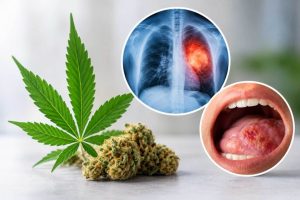
The cannabis cancer risk is no longer a footnote. Two recent clinical cohort studies, one on the lung and one on the mouth, point in the same direction. Adults diagnosed with cannabis use disorder (CUD) went on to develop cancer far more often than adults without the diagnosis. Neither study proves cause, yet both deserve a hard look.
 What the Lung Cancer Study Found
Researchers at the Keck School of Medicine of the University of Southern California analysed electronic records from 67 healthcare organisations across the United States. Their paper appeared in Lung Cancer in 2026. The team matched about 150,000 adults with CUD to about 150,000 adults without it. They balanced age, race, ethnicity, tobacco use, nicotine dependence, alcohol related disorders and chronic obstructive pulmonary disease.
The gap was stark. In the matched analysis, 1,251 people with CUD (0.836%) developed lung or bronchus cancer. In the comparison group, 323 people (0.216%) did. The sample was huge, so the difference is hard to wave away.
That works out as a relative risk of 3.87, with a 95% confidence interval of 3.43 to 4.38. The authors calculated one extra case for every 162 people with the diagnosis.
The signal did not fade. Cancers that appeared at least five years after diagnosis still carried a relative risk of 3.92. In the first analysis, small cell carcinoma, adenocarcinoma and squamous cell carcinoma all ran higher among people with CUD. Those subtype results did not hold at five years, though, and the authors say further research is needed.
Tobacco is the obvious objection, so the team tackled it head on. They removed everyone with documented nicotine dependence or tobacco use. The cannabis cancer risk stayed high, with a relative risk of 4.53. Tobacco use alone carried a relative risk of 8.70. Cannabis and tobacco together reached 10.32.
The Oral Cancer Findings
A second study looked at the mouth. Raphael Cuomo of the University of California, San Diego, published it in Preventive Medicine Reports in 2025. He used records from six University of California academic medical centres and followed 45,129 adults for five years. All had been screened for drug use disorders between 2012 and 2019. Of these, 949 (2.1%) received a new CUD diagnosis.
Oral cancer of the lip or tongue was rare overall, with 106 cases. The cannabis cancer risk still showed up. Even so, the split was clear. It appeared in 0.74% of patients with CUD and 0.23% of those without. After adjusting for age, sex, body mass index and smoking status, the odds ratio was 3.25 (95% CI 1.47 to 7.17). Among tobacco smokers, those with CUD faced an adjusted odds ratio of 6.24.
Why Cannabis Cancer Risk Starts With Smoke
Both teams trace the cancer risk from cannabis to combustion. Cuomo notes that burning cannabis produces polycyclic aromatic hydrocarbons, benzo[a]pyrene and phenols, much like tobacco smoke. The lung study adds that cannabis smoking involves deeper inhalation and breath holding. It also cites research reporting up to four times more tar deposition than tobacco. Cuomo raises a further possibility: THC may weaken immune surveillance in tissue that smoke touches directly.
These are proposed mechanisms, not settled facts. They explain why researchers expected a signal. They do not show how big the effect is for any one person.
What These Studies Cannot Prove
Honest reading matters here. Both studies are observational and rely on diagnostic codes in health records. A CUD diagnosis says nothing about dose, frequency or whether someone smoked, vaped or ate cannabis. The lung authors also note that the risk may reflect heavy use before the diagnosis.
Each team lists gaps. Cuomo had no data on alcohol, human papillomavirus or socioeconomic status. The lung authors could not control for second-hand smoke, workplace exposures or air pollution. However, absolute risks stay low in both cohorts. Nobody should read these cannabis cancer risk figures as a prediction for an individual.
Cutting Cannabis Cancer Risk Starts With Prevention
The exposure behind these numbers is heavy, sustained use. That begins with a first decision to start. Cuomo argues that the findings challenge the idea of cannabis as a risk free substance and urges public health messaging to reflect emerging harms. He also suggests clinicians consider oral cancer screening for people with CUD. The lung authors say clinicians should weigh these risks when advising patients.
Prevention therefore starts early, because the cancer danger from cannabis builds with exposure. Young people who never begin cannot develop a cannabis use disorder. Adults showing signs of problematic use need support before years of exposure pile up. As legalisation spreads, Cuomo stresses that long term monitoring of outcomes, including cancer, will be essential to guide policy.
Dalgarno Institute
Sources: